The cost of chasing validated science: how Pfizer is overpaying for future revenues
Pfizer has spent $88 billion on external innovation since 2018. Majority of that capital sits in just four deals and 37% in one. Jump into the dissection of the dealmaker narrative to find out if this theory holds true for Pfizer.
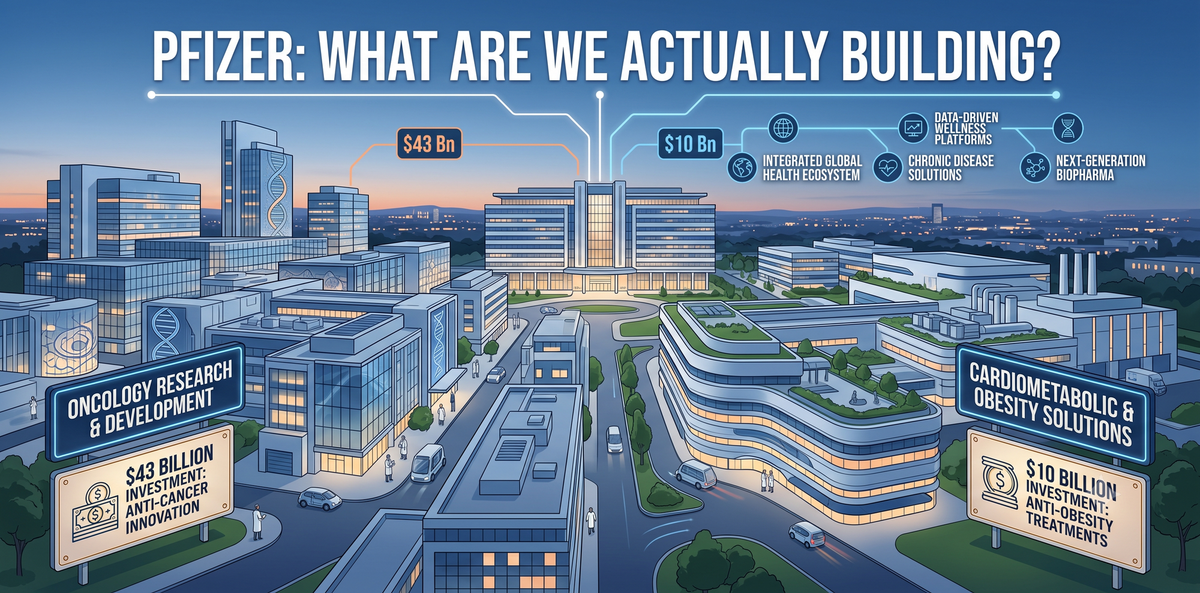
Pfizer has a structural problem that $88 billion could not solve. Since 2018, the company deployed nearly $88 billion in external innovation to refill a pipeline threatened by a 2026 to 2030 patent cliff that will strip away $20 billion in annual revenue. Pfizer's strategy was explicit: buy only validated science, proven in clinical trials, de-risked before acquisition. The logic was sound, the execution wasn't. Majority of that capital concentrated into four deals. Thirty seven percent in a single transaction. Then, in Q4 2025, Pfizer wrote off $4.4 billion of intangible assets when it revised forecasts for acquired and pipeline properties downward. That impairment is not a one-off. It is the mechanism by which the gap between what Pfizer paid for certainty and what the science actually delivered becomes visible on the balance sheet. What the company's capital decisions actually reveal is uncomfortable: a world class balance sheet and a disciplined dealmaking machine can still overpay systematically, because the very certainty Pfizer chases most aggressively is the certainty that expires fastest once you own it.
Chapter 1: Where is Pfizer post-COVID?
Pfizer is no longer riding on COVID boosted revenue wave. In FY2025 the company recorded total revenues of $62.6 Bn, with its non-COVID portfolio growing 6% operationally even as Comirnaty and Paxlovid faded. The profit recovery is real but unfinished. Net profit margin sat at 12.4% in 2025, a fraction of the pandemic peak, while gross margin climbed back to 74.3%. Research productivity is the quiet headline. Pfizer converted roughly $4.30 of gross profit for every $1 of prior year research spend, well ahead of the rough industry middle, yet the engine increasingly runs on bought-in science rather than home grown molecules.
From Brooklyn chemists to a pure play biopharma
Pfizer began in 1849 when Charles Pfizer and Charles Erhart set up a fine chemicals business in Brooklyn. The modern shape of the company, though, was forged by a 25 year run of very large deals. The acquisition of Warner Lambert in 2000 brought Lipitor, Pharmacia in 2003 added Celebrex, and Wyeth in 2009 delivered the Prevnar vaccine franchise that still anchors the portfolio today. The 2010s were about pruning as much as buying. In November 2020 Pfizer spun off its off-patent Upjohn business and merged it with Mylan to create Viatris, and it later exited consumer health through the Haleon demerger. By the time the COVID windfall arrived, Pfizer had deliberately reshaped itself into a pure play, science driven biopharma. The most recent structural pivot was the $43 Bn purchase of Seagen, completed in December 2023, which turned oncology into the company's single largest growth pillar. From my point of view, the throughline across 175 years is consistent: when Pfizer wants to change what it is, it buys the change rather than waiting to invent it.
In 2016, Pfizer attempted $160 Bn tax inversion merger with Allergan but it collapsed under new United States Treasury rules. Denied the tax deal, Pfizer pivoted almost immediately to buying revenue. Within four months it acquired Anacor for $5.2 Bn (the eczema treatment Eucrisa), the antibiotics business of AstraZeneca for up to $1.57 Bn, the gene therapy company Bamboo Therapeutics, and finally Medivation for $14.3 Bn ($13.9 Bn net of cash), which brought the prostate cancer drug Xtandi. The Medivation deal is the one I would flag for any reader trying to understand Pfizer's DNA. Pfizer won it in a contested auction against Sanofi and others, paying $81.50 per share, a 21% premium and well over Sanofi's earlier $52 hostile bid. It is the exact behaviour, chasing a validated asset into an auction and paying the winner's price, that would repeat with Seagen in 2023 and Metsera in 2025. I would rather not call it a pattern but a house style.
Current scale and size FY2025
According to Pfizer's FY2025 Form 10-K and its February 2026 results release, the company posted total revenues of $62.6 Bn, down 2% from $63.6 Bn in 2024, with the decline driven almost entirely by lower COVID product sales. Reported net income attributable to Pfizer was $7.8 Bn and reported diluted earnings per share were $1.36, while adjusted diluted EPS reached $3.22. The business is organised around a single Global Biopharmaceuticals segment that contributed $61.2 Bn of revenue, supported by the Pfizer CentreOne contract manufacturing unit at $1.3 Bn and the Pfizer Ignite services unit at $41 Mn.
One structural change worth noting for anyone tracking Pfizer's history: in 2025 Pfizer decided to discontinue Pfizer Ignite, the end to end research and development services unit it had launched in 2023 and began winding it down. Effective January 2026 Pfizer also created a new Global Hospital and Biosimilars organisation, moving off-patent sterile injectables and biosimilars out of Specialty Care and Oncology. Biopharma remains the main reportable segment. I read both moves as the same instinct that drives the dealmaking: concentrate on the assets that scale, prune the rest. The revenue split unveils an important feature. Pfizer's Oncology slice is now nearly as large as Specialty Care and almost entirely the product of acquired science.
Therapy area revenue mix (FY2025)
Pfizer Biopharma Revenue 2025
Hover or select a pie slice for values
Primary Care includes internal medicine, migraine, vaccines and COVID-19 products. Specialty Care includes rare disease, inflammation & immunology, and anti-infectives. Total Biopharma $61.2 Bn excludes PC1 contract manufacturing ($1.3 Bn) and Pfizer Ignite.
Top brands by commercial portfolio (FY2025)
Top brands by portfolio FY2025
Portfolio groupings reflect Pfizer's commercial structure during FY2025.
Portfolio on a growth-share matrix FY2025
Bubble area proportional to FY2025 revenue. Market growth and competitive position assessments by Author, not company reconciliation.
Reading this matrix with the revenue figures in hand, I see Pfizer's central tension in one frame. Its two biggest cash cows, Eliquis at $8 Bn and the Prevnar family at $6.5 Bn, sit in low growth or soon to expire territory, while its genuine stars, Vyndaqel at $6.4 Bn, Padcev at $1.9 Bn and the rapidly growing Lorbrena at $1 Bn, are smaller. And of those three stars, two were acquired. The high growth high share corner is exactly the gap the company is trying to fill with deals, and its success filling it so far is real but partial.
Financial health across 2023 to 2025
Financial health FY2023 to FY2025
Hover or select a bar for values
The three year arc is a story of a profit engine recovering from a COVID sugar high, not of underlying growth. Revenue is roughly flat, but margins have nearly doubled off the 2023 trough. The 2023 weakness was not operational decay; it reflected roughly $5.5 Bn of non cash inventory write offs for unused COVID products and a $3.5 Bn non cash Paxlovid revenue reversal, both one off events tied to the collapse in pandemic demand. In my opinion the more sobering signal sits in 2025 itself. Reported net income slipped 3% year over year and the fourth quarter swung to a reported loss per share of $0.29, driven by $4.4 Bn of non-cash intangible asset impairments taken when Pfizer revised commercial forecasts for several acquired and pipeline assets.
This is what is called fallout of aggressive dealmaking. When you buy a lot of future revenue, you sometimes have to admit it will be smaller than you paid for. The impairment line is not a single bad quarter, it is a trend. Pfizer's asset write-offs and impairments inside operating cash flow ran at $3.4 Bn in 2023, $4.2 Bn in 2024 and $5.3 Bn in 2025 (Pfizer FY2025 Form 10-K, statement of cash flows). That is a rising line, not a spike. I read it as the delayed invoice on a validate then buy strategy: the science was acquired at full price in prior years and the shortfall against those forecasts is now arriving in instalments.
Research and development investment and output
Pfizer's return on research capital is strong on paper, but the denominator hides the real story. The company is increasingly renting research output from outside rather than generating it internally. Pfizer invested $10.7 Bn, $10.8 Bn and $10.4 Bn in research and development across 2023, 2024 and 2025 respectively, a remarkably flat line for a company of this size. Against that spend, Return on Research Capital, recovered from roughly 3x in 2023 to about 4.3x in both 2024 and 2025. Yet I think the headline flatters the underlying engine. The 2024 and 2025 improvement was powered overwhelmingly by the margin recovery and by acquired revenue from Seagen, not by a surge of internally discovered blockbusters. The most consequential R&D event of the period was arguably negative: in April 2025 Pfizer discontinued danuglipron, its internal oral obesity candidate, after a liver safety signal, ending years of in house metabolic investment in a single announcement. Pfizer has decided that the most reliable way to refill its pipeline is to buy it.
Return on Research Capital Trend
Chapter 2: Open innovation past and present
Pfizer runs every flavour of open innovation at once. It buys whole companies, licenses single molecules, co-develops with biotech peers, invests venture capital through a unit older than most of its targets, and builds AI tools with startups. The centre of gravity has shifted east and toward platforms. In 2025 Pfizer wrote a $1.3 Bn upfront cheque to a Chinese biotech and made obesity its top priority through a contested acquisition. The strategy is explicit and quantified. Pfizer has publicly targeted adding at least $25 Bn in risk adjusted 2030 revenues through business development, and its capital allocation now treats dealmaking as a core pillar alongside dividends. This chapter moves past the portfolio snapshot to examine how Pfizer actually engages the outside world. I find it useful to separate the activity into four modes, because each carries a different risk profile and a different message for anyone hoping to partner with the company.
The four modes of Pfizer open innovation
Inbound innovation is where Pfizer is most visible and most aggressive. This is the company acquiring external intellectual property and capability, and it spans the full spectrum from outright acquisition to single asset licensing. On the acquisition end, the Seagen purchase brought antibody drug conjugate technology and four marketed cancer medicines for $43 Bn. On the licensing end, the 2025 agreement with 3SBio gave Pfizer ex-China rights to a PD-1 by VEGF bispecific antibody for $1.3 Bn upfront plus up to $4.8 Bn in milestones and a $100 Mn equity stake. In between sit equity investments and joint development agreements, such as the long running co-development of vepdegestrant with Arvinas.
Outbound innovation is where Pfizer shares its own assets externally, and here the company is far more selective. The clearest recent example is the 2025 decision, taken jointly with Arvinas, to out license the commercialization rights to vepdegestrant to a third party rather than market it directly. Pfizer also publishes research openly and contributes to scientific consortia, but I believe outbound activity remains a minor key in its overall composition. A company sitting on this much capital tends to be a net buyer of innovation, not a net seller.
Coupled innovation covers bilateral exchanges where both sides contribute and both benefit. The defining example in Pfizer's history is its relationship with BioNTech, which began as a 2018 collaboration on messenger RNA influenza vaccines and became, in 2020, the basis for Comirnaty under a worldwide arrangement that splits gross profit roughly equally between the two companies. The 2023 agreement with Flagship Pioneering is another instance, with each partner committing $50 Mn upfront to explore up to ten programs drawn from Flagship's network of human health companies. These structures share development cost and share reward, and they tend to appear where the science is genuinely novel and the risk too high for either party alone.
Platform and ecosystem innovation is the quietest but, in my opinion, the most strategically interesting mode. Pfizer Ventures, the corporate venture arm established in 2004, invests across a portfolio of more than 40 emerging companies and was reinforced with a $600 Mn commitment in 2018. Pfizer also helped create the Dementia Discovery Fund in 2015 and launched Pfizer Ignite in 2023 to provide end to end research and development services to selected biotech companies. Layered on top is a network of platform collaborations, most notably the multi year artificial intelligence partnership with XtalPi, first signed in 2018 and expanded in 2025 to build a next generation molecular modelling platform. These are not single asset bets; they are options on entire ecosystems and technologies.
Major milestones in Pfizer open innovation
Open innovation milestones
| Year | Partner | Focus area | Deal type | Disclosed value |
|---|---|---|---|---|
| 2016 | Anacor | Inflammation and immunology (Eucrisa) | Inbound acquisition | $5.2 Bn |
| 2016 | AstraZeneca small-molecule antibiotics business | Anti-infectives | Inbound acquisition | Up to $1.575 Bn ($550 Mn upfront) |
| 2016 | Bamboo Therapeutics | Gene therapy | Inbound acquisition | ~$150 Mn upfront plus up to $495 Mn milestones |
| 2016 | Medivation | Oncology (Xtandi, talazoparib) | Inbound acquisition | $14.3 Bn ($13.9 Bn net of cash) |
| 2018 | BioNTech | Influenza mRNA vaccines | Coupled co-development | $120 Mn upfront (up to $425 Mn total) |
| 2018 | XtalPi | AI molecular modelling | Coupled / platform | Undisclosed |
| 2018 | Pfizer Ventures | Venture investing expansion | CVC commitment | $600 Mn fund |
| 2020 | BioNTech | COVID-19 mRNA (Comirnaty) | Coupled, 50/50 gross profit | $185 Mn upfront incl. ~$113 Mn equity |
| 2021 | Trillium Therapeutics | CD47 immuno-oncology | Inbound acquisition | ~$2.26 Bn |
| 2021 | Arena Pharmaceuticals | Inflammation and immunology (etrasimod) | Inbound acquisition | $6.7 Bn |
| 2021 | Biohaven | CGRP migraine (equity stake) | Inbound equity | $350 Mn for 2.6% |
| 2021 | Arvinas | PROTAC ER degrader (vepdegestrant) | Inbound licence + co-dev | $650 Mn upfront, 50/50 |
| 2021 | Beam Therapeutics | In-vivo base editing | Inbound licence / collab | $300 Mn upfront |
| 2022 | Biohaven | CGRP migraine (Nurtec) | Inbound acquisition | $11.6 Bn |
| 2022 | ReViral | RSV antivirals | Inbound acquisition | Up to $525 Mn |
| 2022 | Global Blood Therapeutics | Sickle cell (Oxbryta) | Inbound acquisition | $5.4 Bn |
| 2022 | BioNTech | Shingles mRNA vaccine | Coupled co-development | $225 Mn upfront |
| 2023 | Seagen | Oncology ADCs | Inbound acquisition | $43 Bn |
| 2023 | Flagship Pioneering | Multi-program discovery | Coupled co-development | $50 Mn each + up to $700 Mn/program |
| 2023 | Nona Biosciences | MSLN-targeted ADC | Inbound licence | Undisclosed |
| 2025 | 3SBio | PD-1×VEGF bispecific (SSGJ-707/PF-08634404) | Inbound licence + equity | $1.25 Bn upfront + up to $4.8 Bn milestones + $100 Mn equity |
| 2025 | YaoPharma | In-licensing agreement | Inbound licence | $150 Mn charge |
| 2025 | Arvinas | Vepdegestrant commercialization | Coupled / outbound out-licence | Undisclosed |
| 2025 | Metsera | Obesity incretin / amylin | Inbound acquisition | Up to ~$10 Bn ($47.50/share cash, $4.9 Bn EV, plus CVR up to $22.50/share; final structure $65.60 cash + up to $20.65 CVR) |
| 2025 | XtalPi | AI modelling platform | Coupled / platform expansion | Undisclosed |
| 2025 | Danuglipron (internal) | Oral obesity GLP-1 | Pipeline discontinuation | Write-off |
Two observations jump out at me. First, the deal pace is uneven and clearly capital cycle dependent. Two waves dominate: the 2016 post-Allergan pivot, and the 2021 to 2023 window flush with COVID cash, which saw multi-billion dollar acquisitions almost every year, while 2024 was nearly silent on business development as Pfizer paid down debt. Then 2025 roared back. Second, the modality mix is migrating. The early years lean toward whole company acquisitions of validated Western assets; the most recent moves lean toward licensing platforms and single assets, often originated in China.
On the 2016 to 2026 basis, total disclosed committed capital across 14 disclosed-value deals rises to approximately $108 Bn (author's calculation using headline committed values; not an official company reconciliation). On that fuller basis the concentration is if anything starker: the single Seagen transaction is about 40% of the total, the top four deals (Seagen, Medivation, Biohaven, Metsera) hold roughly 73%, and the five commercial or approved-stage deals hold about 73% as well. Whichever window you choose, the shape is identical. A small number of very large cheques, written for validated assets, dominate everything.
The sourcing model: how Pfizer finds and integrates external innovation
Pfizer's external innovation network is global, but its recent licensing dealmaking has tilted decisively toward Chinese biotech and toward platform technologies rather than purely academic discovery. On the academic and platform side, Pfizer's most durable relationship is with XtalPi, the artificial intelligence and robotics company founded in 2014 by quantum physicists trained at the Massachusetts Institute of Technology. The collaboration began in 2018 with crystal structure prediction and molecular modelling, and in 2025 the two expanded it to build a molecular modelling platform tuned to Pfizer's proprietary chemical space. The research types Pfizer sources externally span the full chain: computational and AI driven discovery through XtalPi, novel modalities such as PROTAC protein degradation through Arvinas and base editing through Beam, and late stage clinical assets through its acquisitions.
On governance, the structures vary by deal. In the Arvinas collaboration, Pfizer and Arvinas agreed to share worldwide development costs, commercialization expenses and profits equally, a true partnership of equals on a single asset. In licensing deals such as 3SBio, Pfizer takes development, manufacturing and commercial control of the asset outside a carved out territory while the originator retains home market rights and receives milestones and royalties. In acquisitions, Pfizer absorbs the science wholesale.
The geographic signal is the one I would underline for any reader watching where the puck is going. Pfizer's classic network was United States and Europe centric, but its highest value 2025 licensing move, the 3SBio bispecific, originated in China, as did a smaller in licensing deal with YaoPharma. In my opinion this reflects a wider industry truth: a meaningful share of the most interesting early clinical oncology assets now emerge from Chinese biotech, and Pfizer has built the deal muscle to access them quickly.
The XtalPi relationship on the ground
Pfizer's most durable platform relationship is with XtalPi and it rewards close attention because it shows exactly what Pfizer wants from an ecosystem bet: a renewable option on a capability, not a molecule. XtalPi was founded in 2014 by a group of quantum physicists trained at the Massachusetts Institute of Technology and it now operates across Cambridge, Massachusetts and Beijing and Shenzhen in China, with Google and Tencent among its early backers. The relationship with Pfizer runs in stages. It began with crystal structure prediction and solid form selection work, formalised into a strategic research collaboration in 2018 to build a hybrid physics and artificial intelligence platform for modelling drug like small molecules. In 2024 the two published a joint research paper validating the first generation XtalPi Force Field, an AMBER-compatible force field that outperformed on small molecule geometry prediction and free energy perturbation calculations for binding affinity. In June 2025 they expanded the collaboration again, this time to build a next generation molecular modelling platform tuned specifically to Pfizer's proprietary chemical space, with XtalPi deploying its XFEP platform for Pfizer's use. The financial terms were not disclosed.
What this reveals, in my reading, is a deliberate contrast with the acquisition playbook. XtalPi also signed a drug discovery deal with Eli Lilly worth up to $250 Mn and works with Johnson and Johnson, so Pfizer does not own the capability exclusively. But Pfizer does not need to. The renewal and expansion cadence, 2018, 2024, 2025, lets Pfizer keep buying more of a validated computational tool as it proves out, rather than acquiring the company and integrating a robotics and cloud operation it has no interest in running. It is the same instinct as the Pfizer Ventures radar, applied to a technology instead of a therapeutic. On the broader AI front, Pfizer has layered in an MIT machine learning consortium from 2018, an Atomwise evaluation, the internal Charlie generative platform, work with PostEra and CeMM, an AWS-based initiative and a January 2026 biomolecular AI collaboration with Boltz. AI is the one category where Pfizer's engagement genuinely compounds year on year rather than spiking and fading.
Startup engagement and corporate venture capital
Pfizer Ventures, also known as Pfizer Venture Investments, was established in 2004 and sits within Pfizer's Worldwide Business Development, Strategy and Innovation organisation, which is the structural point that matters: the venture arm is wired directly into the same function that runs mergers, acquisitions and licensing, so a promising portfolio company is never more than an internal referral away from a full business development conversation. The mandate looks explicit: invest for financial return in areas of current or future strategic interest to Pfizer, at all stages but with a strong bias to early rounds, typically seed through Series B. Pfizer does not require product or technology rights as a condition of investment, which makes it a more attractive cap-table partner than a pure strategic that demands a right of first refusal.
Typical initial cheques run $5 Mn to $20 Mn and the arm co-invests alongside traditional venture funds rather than going at it alone. On capital, Pfizer committed an additional $600 Mn to the arm in 2018 and disclosed a portfolio of more than 40 active companies at that time, with roughly one quarter, about $150 Mn, earmarked for early-stage neuroscience, funding names such as Aquinnah, Autifony, Cortexyme, MindImmune, Mission Therapeutics and Neuronetics. Some trackers put the cumulative commitment closer to $900 Mn once later top-ups are counted, though Pfizer's own current disclosure centres on the $600 Mn figure. Across its life the arm has made well over 200 investments and recorded roughly 48 portfolio exits; as recently as October 2025 it participated in a Mission Therapeutics round and saw an exit in ImCheck Therapeutics.
The operational value of this radar is harder to demonstrate cleanly than the industry narrative suggests. Pfizer's Form 10-Q shows the $350 Mn equity component of its November 2021 Biohaven arrangement as part of a Worldwide Business Development commercialization and licensing agreement for ex-U.S. rights to rimegepant and zavegepant. The venture portfolio's own value shows up less through headline conversions like that one and more through smaller, real events: Nimbus Therapeutics, a Ventures portfolio company, generated $211 Mn of dividend income for Pfizer in 2023 after Takeda acquired its TYK2 inhibitor subsidiary, and Pfizer Ventures participated in a $100 Mn funding round for RefleXion Medical in 2020. Pfizer was also a founding force behind the Dementia Discovery Fund in 2015, a specialist vehicle that raised more than $190 Mn across a dozen or so dementia focused investments. Pfizer Ignite, launched in 2023 and wound down in 2025, extended the engagement model further by offering selected biotech companies paid access to Pfizer's research, development and regulatory capabilities, deepening relationships before any equity or licensing conversation began. The Ignite wind-down is worth flagging as an honest data point: not every ecosystem experiment survives contact with Pfizer's cost realignment programme.
What the portfolio actually looks like
A full survey of the current forty five company active portfolio, cross-referenced against Pfizer Ventures' own annual newsletters, shows the fund is not running one strategy. It is running at least four at once and they rarely overlap. The first is legacy neuroscience optionality. Aquinnah, Autifony, MindImmune and Mission Therapeutics were all named in the original 2018 announcement and Pfizer still holds all four despite ending internal neuroscience discovery that same year. The fund kept a financial window open on a therapeutic area the company walked away from operationally. The second, and now the largest, is core current priority science: oncology, inflammation and immunology and cardiometabolic disease. The 2022 to 2025 cohort leans heavily on two modality clusters Pfizer Ventures names explicitly in its own reporting, next generation T-cell engagers (Cartography, Crossbow, Enara, EvolveImmune, Normunity) and targeted protein degraders (Triana, TRIMTECH), both of which map directly onto the platform priorities Pfizer states for 2026.
The third sits outside any single therapeutic area altogether: platform and infrastructure bets. RefleXion Medical is a radiotherapy device company, National Resilience is biomanufacturing capacity, Saama is an AI and clinical data platform, Prescriber Point is commercial technology and VitaDAO is a blockchain based funding model. None of these produce a drug candidate directly. They produce capability. The fourth is new and narrow: a 2025 China thread. OTR Therapeutics and Vibrant Therapeutics were both funded alongside the establishment of a dedicated China venture vehicle, the same year Pfizer signed its licensing deals with 3SBio and YaoPharma. I read this as the venture arm and the licensing team moving in the same direction at the same time, not a coincidence.
Pfizer Ventures active portfolio FY 2026
| Company | Segment | Relationship depth | Latest disclosed round | Amount | Year |
|---|---|---|---|---|---|
| Anaveon | Oncology | Equity + board seat | Series B | $119 Mn | 2021 |
| Aquinnah Pharmaceuticals | Neuroscience/Legacy | Equity only | Co-investment with AbbVie | $10 Mn | 2017 |
| Arrakis Therapeutics | Oncology | Equity only | Not disclosed | Not disclosed | Not disclosed |
| Artios Pharma | Oncology | Equity only | Series D | $115 Mn | 2025 |
| Autifony Therapeutics | Neuroscience/Legacy | Equity only | Not disclosed | Not disclosed | Not disclosed |
| Autobahn Therapeutics | Neuroscience/Legacy | Equity only | Series C | $100 Mn | 2024 |
| BioGraph 55 | Inflammation & Immunology | Equity only | Not disclosed | Not disclosed | Not disclosed |
| Cartography Biosciences | Oncology | Equity only, lead investor | Series B | $67 Mn | 2025 |
| Crossbow Therapeutics | Oncology | Equity only | Not disclosed | Not disclosed | Not disclosed |
| Curve Therapeutics | Oncology | Equity only, lead investor | Series A | $50 Mn | 2024 |
| DEM Biopharma | Oncology | Equity only | Launch financing | $70 Mn | 2022 |
| Enara Bio | Oncology | Equity only, co-lead | Series B | $32.5 Mn | 2024 |
| Enlaza Therapeutics | Oncology | Equity only | Series A | $100 Mn | 2024 |
| Enodia Therapeutics | Inflammation & Immunology | Equity only, co-lead | Seed | $25 Mn | 2025 |
| EvolveImmune Therapeutics | Oncology | Equity only | Financing round | $37 Mn | 2023 |
| Flare Therapeutics | Oncology | Equity + board seat, co-lead | Series B | $123 Mn | 2023 |
| FoRx Therapeutics | Oncology | Equity + board seat | Series A | $50 Mn | 2025 |
| Greywolf Therapeutics | Oncology | Equity only | Series B total | $99 Mn | 2024 |
| Immunocodex | Inflammation & Immunology | Equity only | Not disclosed | Not disclosed | Not disclosed |
| ImmunOs Therapeutics | Oncology | Equity only | Series B | $75 Mn | 2022 |
| Incendia Therapeutics | Oncology | Equity only | Series A | $65 Mn | 2021 |
| Kestrel Therapeutics | Oncology | Equity only | Series A | $40 Mn | 2021 |
| Levicept | Platform/Infrastructure | Equity only | Series B | £35 Mn | Not disclosed |
| Mediar Therapeutics | Inflammation & Immunology | Equity only | Series B | $75 Mn | 2025 |
| MindImmune Therapeutics | Neuroscience/Legacy | Equity only | Not disclosed | Not disclosed | 2022 |
| Mission Therapeutics | Neuroscience/Legacy | Direct Pfizer BD relationship | Series D | $13.3 Mn | 2025 |
| Montis Biosciences | Inflammation & Immunology | Equity only | Not disclosed | Not disclosed | 2022 |
| Mozart Therapeutics | Inflammation & Immunology | Equity + board seat | Series A extension | $25 Mn | 2023 |
| National Resilience | Platform/Infrastructure | Equity only | Not disclosed | Not disclosed | Not disclosed |
| Nimbus Therapeutics | Oncology | Realized value event | Financing round | $125 Mn | 2022 |
| Normunity | Oncology | Equity only | Series B | $75 Mn | 2025 |
| Nucleome Therapeutics | Inflammation & Immunology | Equity only | Series A | £37.5 Mn | 2022 |
| OTR Therapeutics | China | Equity only, lead investor | Series A | $100 Mn | 2025 |
| Palleon Pharma | Oncology | Equity + board seat | Series B | $100 Mn | 2020 |
| Prescriber Point | Platform/Infrastructure | Direct Pfizer BD relationship | Not disclosed | Not disclosed | 2022 |
| ReCode Therapeutics | Platform/Infrastructure | Equity only, co-lead | Series C | $200 Mn | 2022 |
| RefleXion Medical | Platform/Infrastructure | Equity only | Series C | $105 Mn | 2023 |
| Saama Technologies | Platform/Infrastructure | Direct Pfizer BD relationship | Financing round | $430 Mn | 2021 |
| Storm Therapeutics | Oncology | Equity only | Series C | $56 Mn | 2026 |
| Strata Oncology | Oncology | Direct Pfizer BD relationship | Series C | $90 Mn | 2021 |
| TRex Bio | Inflammation & Immunology | Equity only | Series B | $85 Mn | 2024 |
| Triana Biomedicines | Oncology | Direct Pfizer BD relationship | Launch financing | $110 Mn | 2022 |
| TRIMTECH Therapeutics | Neuroscience/Legacy | Equity only | Seed | $31 Mn | 2025 |
| Vibrant Therapeutics | China | Equity only | Series C | Not disclosed | 2025 |
| VitaDAO | Platform/Infrastructure | Equity only | Institutional round | Not disclosed | 2022 |
| No companies match the selected filters. | |||||
Compiled from Pfizer's own active portfolio disclosure and Pfizer Ventures' annual newsletters, cross-checked against company press releases where available. Individual Pfizer allocations within syndicated private rounds are not publicly disclosed for any company; amounts shown are total round size. Author's compilation, not a company reconciliation.
Pfizer disclosed venture and business development activity by year
The shape of this chart is the single clearest picture of Pfizer's external strategy. It is not a smooth annuity of small bets; it is a series of large, lumpy, opportunistic strikes timed to capital availability, with the venture arm running quietly underneath the whole time. The chart shows the 2016 post-Allergan pivot as a distinct early spike (Medivation and Anacor), a quieter 2017 to 2020, the COVID-cash surge of 2021 to 2023, the near-silent 2024, and the 2025 rebound driven by Metsera and 3SBio. In 2025 specifically, Pfizer deployed approximately $8.8 Bn in business development, primarily the Metsera acquisition.
Venture and BD investments
Click a bar to see that year's disclosed deals.
Non traditional partners: hospitals, patient groups, digital health and AI
Non-traditional open innovation activity
Click any cell to see the sourced detail behind its score.
Intensity score (0 to 3) reflects volume of publicly disclosed Pfizer activity per category and year, as assessed by the Author.
Hospital and health system network activity does not decline steadily after a good early year, it spikes hard exactly once, in 2020, when the HHS Pharmacy Partnership for Long-Term Care Program routed Pfizer's vaccine through CVS and Walgreens into nursing homes and long-term care facilities, alongside a parallel retail network covering roughly 60 percent of US facilities. Before that spike, in 2019, Pfizer's most substantive named health-system relationship was a multi-year alliance with Ochsner Health System to build shared digital trial infrastructure, an event that also anchors the 2019 and 2022 digital health cells since the same partnership kept reporting progress. After 2020, hospital network activity never returns to that intensity; the closest it comes is 2024, when Pfizer's own proxy statement credited the US Commercial Division with securing key vaccine and health system contracts that helped drive a 39 percent revenue increase.
Patient advocacy and registries follows a different rhythm entirely: three consecutive years of genuine institution building, the Rare Disease Registries Patient Council in 2019, the Accelerating Health Equity Grants program in 2020, and the Institute for Translational Equitable Medicine in 2021, followed by five quieter years until the Gavi one billionth dose milestone in 2025. I read this as a company that built its patient advocacy infrastructure in a concentrated three year window and has been running it since, rather than continuously adding new named programs.
AI and machine learning is the one row where I found something in nearly every year, and where the intensity genuinely compounds rather than spiking and fading. It opens strong in 2018 with three simultaneous partnerships, MIT's Machine Learning for Pharmaceutical Discovery and Synthesis Consortium, the XtalPi molecular modelling partnership, and an Atomwise platform evaluation, goes quiet for three years, then reaccelerates from 2023 onward: AI-driven manufacturing gains disclosed in 2023, the Charlie generative platform and expanded PostEra and CeMM work in 2024, an expanded XtalPi collaboration plus the AWS-based PACT initiative in 2025, and a new biomolecular AI collaboration with Boltz announced in January 2026. Digital health and wearables tells a related but distinct story, climbing to its own high point in 2025 with the consumer facing Health Answers by Pfizer launch, after a 2024 cachexia trial that Pfizer called "a revolution" in how the company runs trials.
Chapter 3: Capital deployment analysis
Follow the committed capital and the strategy becomes obvious. From 2018 to mid 2026, the overwhelming majority of Pfizer's external capital flowed into oncology and, very recently, obesity. Pfizer prefers proven over speculative. Its largest cheques went to commercial or approved assets ($60.6 Bn across five deals), not to preclinical science, which it accesses more cheaply through venture and platform deals. The strategy is a market penetration play first and a diversification play second, in classic Ansoff terms.
Therapeutic area weighting by committed external capital
The concentration is stark. Oncology alone absorbs more than two fifths of all disclosed committed capital, with the single Seagen transaction dwarfing everything else. I believe this confirms that, despite the vaccines reputation, cancer is the true strategic obsession of Pfizer's external innovation. Obesity, effectively a standing start before 2025, has already vaulted to the second tier on the strength of one deal.
Committed external capital by therapy area
Hover or select a slice for values.
- Oncology
- Migraine & Neuroscience
- Inflammation & Immunology
- Obesity & Cardiometabolic
- Rare Disease & Hematology
- Anti-infectives & Vaccines
Source: Pfizer filings and press releases, compiled by the Author. Total committed capital of $108.3 Bn spans 14 disclosed-value deals.
Strategy mapping: Ansoff's matrix
Open innovation moves on an Ansoff growth matrix
Disclosed-value deals, 2016 through July 2026.
- Global Blood TherapeuticsSickle cell$5.4 Bn
- ReViralRSV$0.5 Bn
- MetseraObesity and cardiometabolic$10.0 Bn
- BiohavenMigraine and neuroscience, equity stake plus acquisition$12.0 Bn
- SeagenOncology$43.0 Bn
- MedivationOncology$14.3 Bn
- Trillium TherapeuticsOncology$2.3 Bn
- Arena PharmaceuticalsInflammation and immunology$6.7 Bn
- AnacorInflammation and immunology, dermatology$5.2 Bn
- ArvinasOncology, breast cancer$0.7 Bn
- 3SBioImmuno-oncology$6.1 Bn
- Beam TherapeuticsBase editing$0.3 Bn upfront
- XtalPiAI discovery platformUndisclosed
- ADC technology stack (via Seagen)Counted in Market Penetration, not double-counted here
Bamboo Therapeutics, gene therapy, $0.6 Bn: a capability acquisition rather than a market or product move in the Ansoff sense.
Classification by Author based on Pfizer's commercial footprint at time of deal. Dollar values rounded to one decimal.
The bulk of Pfizer's capital sits in the market penetration quadrant, deepening an oncology position it already holds. The genuinely bold moves, Metsera into obesity and Biohaven into migraine, sit in the diversification corner, which is also where the integration risk is highest. In my opinion this is a defensible balance: anchor the spend in what you know, take a smaller number of large diversification swings where the market is too big to ignore.
Stage preference by committed capital and deal count
Deals by development stage
Deal values captured at the time of entry. Total committed capital of $108.3 Bn spans 14 disclosed-value deals. Source: Pfizer filings, compiled by the Author.
This is, for me, the most revealing chart in the chapter. Classifying each deal against its verified regulatory status at entry, sharpens the picture that the combined bucket blurs. The five Commercial or Approved stage deals absorb $60.6 Bn, which is 69% of all committed capital, driven overwhelmingly by a single $43 Bn transaction. Phase II holds three deals worth $16.7 Bn, but $10 Bn of that is one deal, Metsera, struck at auction after Pfizer's own internal obesity candidate failed. Phase III contains exactly one deal, Arena at $6.7 Bn. The earlier stages hold five deals that together account for just $3.8 Bn. The risk posture is deliberate: Pfizer concentrates real capital on assets where the science is already proven and uses numerous early stage bets to keep watch over emerging platforms.
Modality preference by committed capital
The modality story tracks the science cycle of the industry. Pfizer's biggest single year, 2023, was entirely an antibody drug conjugate bet through Seagen. The 2025 wave splits between bispecific antibodies, via 3SBio, and metabolic peptides, via Metsera. I read this as a company that follows modality fashion deliberately, paying to enter a hot modality once it has clinical validation rather than pioneering it from scratch.
Committed external capital by modality
Hover or select a bar to see that year's deals.
Source: Pfizer filings, compiled by the Author.
The key bets in clinical detail
A deal ledger tells you what Pfizer paid. It does not tell you whether the science justified the cheque. Here is the clinical substance behind the three bets that matter most to the current thesis.
Metsera's MET-097i (now PF-08653944 / PF'3944), the obesity anchor. This is the asset the $10 Bn was really for. MET-097i is an injectable, fully biased, ultra long acting GLP-1 receptor agonist engineered for weekly and, ultimately, monthly dosing, which is its differentiation: Novo Nordisk's Wegovy and Eli Lilly's Zepbound are weekly, so a credible monthly incretin would be a genuine convenience and adherence advantage in a market where real world persistence is poor. In the Phase 2b VESPER-1 trial (NCT06712836), MET-097i produced mean placebo subtracted weight loss of up to 14.1% after 28 weekly doses at the 1.2 mg dose, with individual responses as high as 26.5% and only 2.9% total study discontinuation. For comparison, a 2.4 mg weekly dose of semaglutide has been tied to roughly 9.6% to 12% weight loss at 28 weeks in prior trials. Tolerability was the headline claim: at higher doses without titration, nausea risk difference from placebo ranged 4% to 23%, vomiting 4% to 15%, diarrhoea 0% to 13%, described by Metsera as potentially class leading.
In February 2026, after the acquisition closed, Pfizer reported VESPER-3 (NCT06972720) monthly maintenance data: 10% and 12.3% placebo-adjusted weight loss at 28 weeks on the low and medium monthly regimens it plans to carry into Phase 3, from a trial of roughly 250 to 268 adults. The companion asset, MET-233i, is a monthly amylin analog in Phase 1, being developed both as monotherapy and in combination with MET-097i; Metsera reported 8.4% placebo adjusted weight loss at 36 days for weekly amylin monotherapy. Pfizer highlighted both PF'3944 and the PF'3945 (MET-233i) combination at its January 2026 JPMorgan presentation, with Phase 2 data for the lead expected across 2026. Pfizer bought a Phase 2b asset with strong but not yet pivotal data and the value of the deal rests entirely on Phase 3 confirmation that has not happened yet.
The 3SBio bispecific SSGJ-707 (PF-08634404), the oncology bet. This is a bispecific antibody targeting PD-1 and VEGF, developed on 3SBio's proprietary CLF2 platform. The mechanism matters because the entire class was validated when Akeso and Summit's ivonescimab beat Merck's Keytruda in a head to head Chinese Phase 3 lung cancer trial, triggering an industry scramble in which Merck paid $588 Mn and BioNTech $800 Mn to secure their own PD-1/VEGF assets. Pfizer's $1.25 Bn upfront (plus up to $4.8 Bn milestones, $100 Mn equity, and a $150 Mn option on China rights) was the most expensive entry, prompting one analyst note that Pfizer was paying the fee for being late to the market. The asset was in several Chinese Phase 2 trials at signing, across non-small cell lung cancer, metastatic colorectal cancer and gynecological tumours. ASCO 2025 poster data in previously untreated PD-L1-expressing NSCLC showed tumour shrinkage in about two-thirds of patients at the 10 mg dose, but with near universal adverse events including liver enzyme elevations and, at the 20 and 30 mg doses, more than half of patients experiencing severe or medically significant side effects. By November 2025 Pfizer had moved the molecule into two pivotal Phase 3 studies, one in first line lung cancer against Keytruda plus chemo, one in front line colorectal. Whether PD-1/VEGF bispecifics can beat Keytruda on overall survival in Western trials remains the open question of the field and it is the risk Pfizer has taken on.
Vepdegestrant (ARV-471), the Arvinas partnership. This is a PROTAC oral estrogen receptor degrader for ER+/HER2 breast cancer and it is the first PROTAC ever taken into a Phase 3 trial. In the pivotal VERITAC-2 study (NCT05654623), reported topline in March 2025, vepdegestrant met its primary endpoint in the ESR1-mutant population, beating the pre-specified hazard ratio of 0.60 for progression free survival versus fulvestrant, but it did not reach statistical significance in the broader intent to treat population. ASCO data in May 2025 quantified the ESR1m benefit as a 2.9-month improvement in median progression-free survival, published simultaneously in the New England Journal of Medicine. Arvinas submitted a US New Drug Application in June 2025 for the ESR1-mutant indication. The mixed result, a clear win in the mutant subgroup but a miss in the all comers population, is precisely what then reshaped the commercial economics.
Trial phase progression of acquired assets
Tracking the assets forward shows both the wins and the warnings. Vepdegestrant advanced to a filing with a regulatory action date in June 2026, and the 3SBio bispecific moved into Phase III. But the chart also carries a cautionary line: Oxbryta, the sickle cell drug Pfizer paid $5.4 Bn for, was voluntarily withdrawn from global markets in 2024 over a safety signal, a reminder that buying an approved asset does not buy certainty.
Asset entry vs current phase
Hover or select a sankey line to see details.
Status per Pfizer pipeline disclosures and partner releases, compiled by the Author.
The bets that failed: a dedicated impairment ledger
Open innovation narratives celebrate the deals and bury the failures. Pfizer's record holds both and the failures deserve to be gathered in one place rather than scattered across footnotes. Here is the itemised ledger of disclosed impairments, withdrawals, discontinuations and terminated programs since 2016, with entry cost, charge and disclosed reason where available.
Oxbryta (voxelotor), sickle cell disease. Entered via the $5.4 Bn Global Blood Therapeutics acquisition in 2022. Voluntarily withdrawn from all global markets in September 2024 after clinical data showed an imbalance in vaso-occlusive crises and fatal events (eight deaths versus two in placebo in a 236 patient pediatric study). Revenue had been $328 Mn in 2023; Pfizer had projected peak sales above $2 Bn. This is the clearest single case of an approved asset acquisition destroying most of its own value.
Danuglipron (PF-06882961), internal oral GLP-1. Not an acquisition but an internal program written off, discontinued in April 2025 after a single asymptomatic participant in a once daily dose optimisation study experienced potential drug induced liver injury. An earlier twice daily formulation had already been abandoned in 2023 due to discontinuation rates above 50%. The strategic consequence, an empty internal obesity cupboard, is what forced the $10 Bn Metsera auction.
Q4 2025 intangible impairments, $4.4 Bn total. Per the FY2025 Form 10-K, the full year 2025 charge comprised approximately $3.9 Bn of IPR&D impairments, itemised as roughly $1.6 Bn for disitamab vedotin, $820 Mn for Tukysa (tucatinib) and $820 Mn for osivelotor, plus roughly $1 Bn for certain US sterile injectable and hospital products. The detail matters: disitamab vedotin and Tukysa are both Seagen derived oncology assets and osivelotor is a global blood therapeutics sickle cell asset. In other words, the largest single impairment year is substantially a write-down of the two most expensive acquisitions.
2024 intangible impairments, $2.9 Bn (Biopharma segment). Composed of $1 Bn for B7H4V (felmetatug vedotin, a Phase 1 IPR&D asset), $475 Mn for Medrol, $435 Mn for Zavzpret developed technology, $400 Mn for Tukysa and $200 Mn for disitamab vedotin (both reflecting emerging competition), and $436 Mn of other assets, plus a separate $240 Mn charge tied to a discontinued Phase 3 Duchenne muscular dystrophy program.
2023 intangible impairments, roughly $3.0 Bn. Composed of $1.4 Bn for etrasimod (Velsipity) IPR&D on reduced indication and revenue expectations, $964 Mn for Prevnar 13 developed technology on the transition to higher serotype vaccines and $486 Mn of other assets. Etrasimod is the asset Pfizer paid $6.7 Bn for through Arena; the impairment landed within two years.
2025 mid-year IPR&D impairments. A $260 Mn charge for inclacumab (a Phase 3 sickle cell asset, another GBT program) on unfavourable trial results, and a $210 Mn charge for KRAS G12D, a Phase 2 out-licensed asset discontinued by the partner.
Arena pipeline pruning. Of the $6.7 Bn Arena acquisition, only etrasimod was retained; Pfizer discontinued temanogrel, APD418 (which held FDA fast track designation) and other mid stage Arena programs in 2023.
The lesson I draw is sober and specific: a buy the pipeline strategy transfers scientific risk onto the balance sheet, where it surfaces as impairment if the science disappoints. And because Pfizer buys late and expensive, the impairment arrives at or near full acquisition price. Tukysa, disitamab vedotin and osivelotor did not become cheaper to write down because Pfizer had paid a premium for them; if anything the premium is exactly what made the write down large.
The obesity pivot: Institutional memory meets a market too large to skip
The $10 Bn Metsera acquisition reads differently when seen against Pfizer's historical strength in chronic metabolic disease. Lipitor, acquired through the 2000 Warner Lambert purchase, became one of the most prescribed drugs in history, reaching annual sales peaks near $13 Bn in the mid-2000s. Lipitor succeeded not because it pioneered dyslipidemia treatment, but because Pfizer had the primary care infrastructure, payer relationships, patient identification machinery, and formulary dominance to turn a large prevalence prophylactic indication into a franchise. The assets were validated before acquisition. The competitive advantage was in commercial scale and adherence management.
Obesity presents Pfizer with a structurally similar opportunity, but one it nearly missed. The company's internal obesity candidate, danuglipron, reached Phase II before a hepatic safety signal forced discontinuation in April 2025. That failure stripped away an option to build category leadership organically. By contrast, Novo Nordisk and Eli Lilly had already shaped the obesity narrative through Ozempic, Saxenda, and Mounjaro. Pfizer's choice to commit $10 Bn for Metsera, in a contested auction against Novo itself, signals a deliberate strategic decision: the obesity market will reach $100 Bn to $150 Bn by the early 2030s, and Pfizer cannot afford a repeat of the historical window it missed in obesity management. The Metsera assets are Phase II peptide incretin candidates, not approved medicines, placing them in what Pfizer usually avoids. But the market scale and Pfizer's proven playbook in metabolic disease management justified the premium paid for entry.
In effect, Pfizer is deploying the Lipitor playbook backward: instead of waiting for validation before building infrastructure, it is buying the validated asset first and applying the institutional machinery it built decades ago to a market that did not exist then. This is not novelty seeking. It is the company paying a premium to recover a position it has always been strong in but lost the chance to own early. Read this way, the $10 Bn reflects not opportunism but disciplined capital allocation based on historical competitive advantage in a market segment Pfizer knows how to dominate.
Chapter 4: Strategy and its implications
Pfizer's external portfolio is dense in the safe cells and thin in the speculative ones. It is well stocked with late stage, core and adjacent assets, and largely empty in the new domain, early stage cells. The obesity move is the exception that proves the rule. Metsera is Pfizer's one large bet in a new domain and it cost a bidding war to secure. The real challenge is not capital. It is whether a company this good at buying validated assets can also win in markets where the science is still unsettled.
External innovation complementarity grid
Author's analysis and interpretation, not company reconciliation.
The grid exposes the shape of Pfizer's strategy with uncomfortable clarity. The upper left, late stage and core, is crowded and expensive, dominated by the Seagen pill. The right hand columns, expansionary and new domain, are sparse, and the bottom right, early stage new domain, is essentially empty. This is the portfolio of a company that buys conviction, not optionality. I believe the core strategic challenge sits in exactly that pattern. Pfizer has become superb at one thing: identifying assets that have already cleared meaningful scientific risk and paying top dollar to own them. That skill produced the oncology franchise and, through Metsera, a credible obesity entry. But it carries three structural problems that I think the company has not fully solved.
First, there is the price of waiting for validation. By the time an asset has reached Phase II and demonstrated proof of concept, the market has priced it, and Pfizer ends up in auctions. The Metsera saga is the cautionary tale: what began as a $4.9 Bn agreement escalated into a public bidding war with Novo Nordisk, with the United States Federal Trade Commission intervening, and ended at a headline value of up to roughly $10 Bn after Pfizer raised its cash offer to $65.60 per share plus a contingent value right. Winning cost roughly double the opening bid. A strategy that systematically buys validated assets is a strategy that systematically pays auction prices.
Second, there is the patent cliff racing toward the core. Pfizer itself has flagged that several of its largest products, including Eliquis, Vyndaqel, Ibrance, Xeljanz and Xtandi, face loss of exclusivity across the 2026 to 2030 window. The acquired oncology and obesity assets are meant to fill that hole, but the timing is tight. The grid's crowded upper left needs to convert into revenue before the cash cows expire, and the impairments of late 2025 suggest at least some of those acquired forecasts are already being trimmed.
Third, there is the thin right hand side. Because Pfizer accesses early and speculative science mainly through small venture and platform bets, it has limited proprietary depth in genuinely new domains beyond obesity. If the next large market emerges from a modality Pfizer has not bought into, the company will once again be a late, expensive entrant rather than an owner. From my point of view, the central question facing Pfizer's strategy team is not whether they can afford the next big deal. With this balance sheet, they can. The question is whether a company optimised to buy certainty can build the muscle to win where certainty does not yet exist.
Chapter 5: What is Pfizer actually building?
Pfizer's stated bet is that a world-class balance sheet combined with a validate-then-buy strategy can generate the revenue needed to clear a 2026-to-2030 patent cliff threatening $20 Bn annually. The data below shows the bet is coherent but the execution is concentrated, the impairments are already arriving, and the company has paid a premium for strategic positioning in only one new domain.
Pfizer's research return on capital of 4.3x is almost entirely carried by one acquired asset class, Seagen, not by internal discovery. Portfolio concentration is extreme: majority of all committed external capital sits in four transactions, and 37% in a single deal. The $4.4 Bn of Q4 2025 intangible impairments signal that the validate-then-buy model has a built-in downside asymmetry: when acquired assets fail, impairments hit at full acquisition price, not at the entry prices of earlier bets. Pfizer's historical dominance in chronic metabolic disease, earned through Lipitor, explains the Metsera premium in a way that generic market entry logic cannot. The real strategic risk is not deal size. It is whether a company this effective at buying validated late-stage assets can also generate returns in markets where the science is still unsettled.
The 4.3x RoRC is a borrowed number, not a built one
Internal R&D spend across 2023, 2024 and 2025 held almost flat, at $10.7 Bn, $10.8 Bn and $10.4 Bn respectively. Gross profit across the same years moved from $34.6 Bn to $46.5 Bn, a $11.9 Bn improvement. That gap drove RoRC from 3.0x to 4.3x. Simultaneously, within the R&D line itself, acquired in-process R&D charges jumped from $108 Mn in 2024 to $1.6 Bn in 2025, a 15x increase in a single year. Author's calculation; not an official company reconciliation. The internal research engine did not become 43% more productive between 2023 and 2025. Seagen's approved commercial revenues landed in the gross profit numerator while the R&D denominator barely moved. The RoRC improvement is structural, not scientific. A company could present identical figures while its own labs were producing nothing new, provided it had acquired enough revenue elsewhere. Pfizer's 2025 trajectory fits that description.
Four deals own the majority, one owns nearly half
Across the disclosed value transactions from 2016 to mid 2026, the five commercial or approved stage deals absorb roughly $79 Bn of about $108 Bn committed, which is around 73% (author's calculation using headline committed values; not an official company reconciliation). This concentration sharpens further when individual deals are examined: the single Seagen acquisition at $43 Bn accounts for about 40% of all committed capital. The breadth across fourteen deals looks diversified by count. By dollars it is a spike: a handful of transactions at one stage in one area.
Metsera's $5.1 Bn auction premium was the cost of having no Phase III obesity data internally
The Metsera saga is instructive when the numbers are laid side by side. The September 2025 opening bid was $4.9 Bn for a company whose most advanced asset was in Phase II, with no Phase III readout and no approved product. After seven weeks and a bidding war with Novo Nordisk, Pfizer closed at $65.60 per share cash plus a contingent value right, producing an upfront enterprise value of $7 Bn and a total potential value of roughly $10 Bn. The premium above the opening bid was approximately $5.1 Bn, on an asset that had not moved one phase in those seven weeks (Author's calculation based on disclosed transaction values). That $5.1 Bn is the precise and measurable cost of Pfizer's prior choice to wait for validation rather than build early. Danuglipron, its own oral GLP-1, was discontinued in April 2025 after a liver signal. Pfizer had no validated internal obesity asset. The auction price it paid in November 2025 is the direct financial consequence of that gap, priced in real time by a competing bidder.
The cheapest moment to catch an asset is always the moment Pfizer chose not to
Two data points bracket the actual cost curve of Pfizer's risk appetite. In November 2021, Pfizer Ventures invested $350 Mn for a 2.6% stake in Biohaven, a migraine-focused biotech. Eleven months later, in October 2022, Pfizer acquired the company for $11.6 Bn, paying 33x the initial entry price. The earlier the entry, the lower the price per unit of validated science. The 3SBio license signed in July 2025 cost $1.3 Bn upfront for ex-China rights to a Phase II PD-1/VEGF bispecific antibody. Seagen, which brought approved ADC products and a deep pipeline, cost $43 Bn. The gap between $1.3 Bn for Phase II access and $43 Bn for approved access is not simply stage risk premium; it is the compounding cost of waiting. Pfizer has demonstrated that it can identify good science early, through Pfizer Ventures and platform relationships established in 2004 and 2018 respectively. It then systematically waits until the science is expensive before deploying its largest capital. The Biohaven sequence did not change that behavior. Neither, so far, has the 3SBio one.
So What?
SWOT: internal capabilities versus external forces
- Balance sheet and dealmaking strength to win contested big Bn+ acquisitions.
- Gross margin recovered to 74.3%, generating substantial reinvestable cash.
- Pfizer Ventures (40+ portfolio) provides early visibility into emerging science.
- Proven track record integrating large oncology platforms.
- AI partnership with XtalPi expands molecular design capability.
- Flat R&D output despite $10.4 Bn investment; danuglipron failure signals external dependence.
- Systematic overpayment for acquired assets; $4.4 Bn Q4 2025 impairments prove recurring write-downs.
- Thin early-stage pipeline outside obesity and oncology.
- Heavy reliance on cash cows facing 2026-2030 LOE; $20 Bn annual revenue at risk.
- Obesity market forecast at $100-150 Bn by early 2030s; sustained 8-10% annual growth.
- Expanding supply of validated clinical-stage assets from Asia and China biotech.
- AI-driven discovery accelerating industry wide; reduces cycles, improves hit rates.
- Strong market growth in ADC and bispecific antibody modalities.
- Auction dynamics inflate late stage asset prices; Metsera bidding contest proves it.
- Entrenched obesity leaders with marketed products and patient access limit Pfizer differentiation.
- Pricing pressure from MFN, IRA redesign and international reference pricing.
- Tariff and trade policy uncertainty threaten licensing, manufacturing and supply chain.
Author's interpretation of Pfizer's SWOT, not company reconciliation.
The findings above connect to a single underlying claim about what Pfizer's capital decisions actually reveal. The company's stated bet is that a world class balance sheet combined with a validate then buy strategy can generate the revenue growth needed to clear a 2026 to 2030 patent cliff that threatens approximately $20 Bn of annual revenue from Eliquis, Vyndaqel, Ibrance, Xeljanz and Xtandi simultaneously.
The data in this piece suggests the bet is coherent but the pricing is punishing. The RoRC of 4.3x looks healthy until you understand it is almost entirely carried by one acquired asset class, the Seagen oncology portfolio, not by internal discovery. The portfolio looks diversified until you discover that 69% of all committed capital sits in four transactions and 37% in one. The obesity pivot looks bold until you price the $5.1 Bn premium Pfizer paid for being absent from the space when Novo Nordisk showed up at the same auction.
The number that deserves the most attention going forward is not the deal size. It is the $4.4 Bn of Q4 2025 intangible impairments, because it is the mechanism by which the gap between acquisition price and actual performance closes. Pfizer paid approximately $88 Bn in committed capital across 14 disclosed value deals from 2018 to mid-2026. Portions of that capital are already being written down. More will follow if the Seagen 2030 revenue projection of greater than $10 Bn, set at announcement in March 2023, does not materialise, or if the Metsera obesity portfolio encounters Phase III attrition. The arithmetic of validate then buy works when the validated asset delivers on its validation. When it does not, the impairment arrives at full acquisition price, not at the discounted entry price that earlier, smaller bets would have provided. That asymmetry is Pfizer's actual strategic risk, and it is already showing up in the numbers.
Methodology and Disclaimer
This is a personal analytical perspective on Pfizer's external innovation strategy based exclusively on publicly available information (SEC filings or equivalent, press releases, investor disclosures) current as of June 2026. This is NOT financial, investment, legal, or strategic advice. It does not constitute a recommendation to buy, sell, or invest in any company, security, or asset. Before making any decisions, readers must consult qualified financial advisors, investment professionals, and legal counsels.
While I have cross-checked sources and taken care to ensure accuracy, errors and omissions are possible. The onus of final verification lies entirely with the reader. I assume no liability for any losses, damages, or consequences resulting from reliance on this content. Drug development is inherently uncertain; all forward-looking statements about pipeline progression, market potential, or strategic outcomes are subject to significant risk and may not materialize. I have no financial interest in, affiliation with, or endorsement relationship with the company or any entities mentioned herein.
Feedback, corrections, and alternative perspectives are welcome. If you would like to collaborate or contribute or even borrow some analytical piece from this post, write to info@kletthamerinsights.com.
Sources used in this blog
- Pfizer Inc. Pfizer Reports Solid Full-Year 2025 Results And Reaffirms 2026 Guidance. February 3, 2026. s206.q4cdn.com
- Pfizer Inc. PFE Financials and key ratios (FY2025 gross margin, net margin). StockTitan. 2026. stocktitan.net
- History Tools. Pfizer Acquisitions and Mergers: From Warner to Seagen. 2024. historytools.org
- Pfizer Inc. Form 10-K for fiscal year ended December 31, 2025 (Defined Terms: Upjohn Business, Viatris, Haleon). Filed February 26, 2026. sec.gov
- Pfizer Inc. Pfizer Completes Acquisition of Seagen. December 14, 2023. pfizer.com
- Pfizer Inc. Form DEFA14A (patients reached disclosure). April 2025. sec.gov
- Pfizer Inc. Pfizer and BioNTech collaboration background (Form 10-K Defined Terms and Comirnaty disclosures). 2026. sec.gov
- Biohaven Pharmaceutical Holding Co. Ltd. Form 8-K, Pfizer acquisition and prior equity stake. May 2022. sec.gov
- Pfizer Inc. Pfizer Reports Strong Full-Year 2024 Results And Reaffirms 2025 Guidance. February 4, 2025. businesswire.com
- Pfizer Inc. Form 8-K, third quarter 2023 update on COVID product charges and revenue guidance. October 13, 2023. sec.gov
- MacroTrends. Pfizer Research and Development Expenses 2012 to 2025. 2026. macrotrends.net
- Pfizer Inc. Form 8-K, danuglipron discontinuation. April 2025. sec.gov
- Pfizer Inc. Form 8-K, Flagship Pioneering collaboration. July 2023. sec.gov
- Pfizer Inc. Pfizer to Expand Venture Investing with $600 Million Commitment to Pfizer Ventures. June 6, 2018. pfizer.com
- XtalPi Inc. and Pfizer Inc. XtalPi and Pfizer Expand Strategic Collaboration to Advance AI-Driven Drug Discovery. June 29, 2025. prnewswire.com
- Pfizer Inc. Pfizer Completes Licensing Agreement with 3SBio. July 24, 2025. pfizer.com
- Pfizer Inc. Pfizer Completes Acquisition of Metsera. November 2025. pfizer.com
- Pfizer Inc. Form 8-K, third quarter 2022 (business development $25 billion 2030 revenue target). November 1, 2022. sec.gov
- Pfizer Inc. and Arvinas Inc. Arvinas and Pfizer global collaboration for vepdegestrant (ARV-471). October 15, 2023. pfizer.com
- Arvinas Inc. Arvinas Provides Update on Collaboration with Pfizer. September 17, 2025. ir.arvinas.com
- Contract Pharma. Pfizer company profile (Trillium and Beam collaboration history). August 2025. contractpharma.com
- Contract Pharma. Pfizer company profile (Beam Therapeutics base editing, Nona Biosciences ADC). August 2025. contractpharma.com
- Reuters via U.S. News. Flush With Cash, Pfizer Buys Global Blood Therapeutics; Arena and Biohaven context. August 8, 2022. money.usnews.com
- Global Blood Therapeutics Inc. Form 8-K, Pfizer to Acquire Global Blood Therapeutics for $5.4 Billion. August 8, 2022. sec.gov
- StartupIntros. Pfizer Venture Investments overview (established 2004). 2026. startupintros.com
- Nasdaq via Zacks. Pfizer faces loss of exclusivity 2026 to 2030 for Eliquis, Vyndaqel, Ibrance, Xeljanz, Xtandi. August 5, 2025. nasdaq.com
- IQVIA. The outlook for obesity from 2026 to 2030 (global obesity medicines market). April 2026. iqvia.com